Showing posts with label Travelogue. Show all posts

Tuesday, December 2, 2008

Squidoo Here I Come!

Thanks to KC Lau, whose book I review in my alternate blog, http://wealthwellnessnetwork.blogspot.com.

I have started to write my page on Self Traveling,
http://www.squidoo.com/Travel-on-your-own?mb=lens_publish.

I have signed up "Lens of the Day newsletter" at
http://blogs.squidoo.com/lensoftheday/,

as well as received the official Squidoo recipe book,
http://sethgodin.typepad.com/changethis/files/TheJoyofSquidoo.pdf.

I will update with more pages.

Wednesday, November 26, 2008

Padi Museum

Fancy taking a bus trip up North to visit the magnificent Padi Museum? That was what I did over the weekend, 22 & 23 November 2008, with my community friends, most of them are my taichi-mates!

The Padi Museum is situated at the foot of Gunung Keriang, 8 km North of Alor Star. Gunung Keriang, locally known as Crystal Mountain, is an outcrop of crystallised stones, harvested by locals for sales just below the hill!

The Padi Museum was constructed in 2000 with six (or five?) cylindrical structures resembling padi stalks. The main structure high in the middle is where the attraction is.


Walking up the staircase, there is a circular movable platform for you to sit and view the beautiful 3-D painting on the wall facing you. The painting runs continuously as a cylindrical piece!

This circular mural measures 103 metres in circumference and 8 metres in height. It was drawn by 50 artists from North Korea.

The following shots were taken. A scene of a kampung community.


The padi field, may not believe that it is a painting indeed.


Note that the plants at the foreground are actually preserved realia.


A scene beside the Crystal Mountain. Again, objects at the foreground are realia.


The beautiful rainbow, this is most likable part of the painting.


One has to pay RM2 to bring in a camera. You will be given a small card with a rubber band to tie around your camera. There is this hard-working officer checking if your camera, particularly hand-phone with a camera function, is smuggled in without making any payment. She would stop you from taking photographs. This photo shows a person sitting on the revolving platform, while the officer stands on the permanent inner platform. Over her back, a group of spectators are viewing the painting facing the opposite side. The roof shows its circular structure.


There are four or five circular halls with fixed paintings at the middle level of the building. These paintings include of the history of padi cultivation and various scenes of padi field.


At the lowest level, there is a souvenir shop and a wide area of exhibition on anything related to padi, padi farming and rice, The "Tikus Bodoh" is the most attractive exhibit of all, a mouse trap!


It is educational, yet it is so cheap to visit as the entrance fee is only RM3 for adult and RM1 for children and student.

There is a canteen at the periphery of the Padi Museum compound, serving good local food and drink! The canteen operator's school-going children speak perfect English!

Saturday, July 5, 2008

Eravikulam National Park India

On Merdeka Day 2007, I made a trip to a wonderful national park in India. It is the best managed national park I have ever visited, the 97 square km Eravikulam National Park in the state of Kerala. It is 2000 meters above sea level, with the highest peak called Anamudi (2690 m).


Eravikulam National Park is famous for two species, a fauna and a flora. The Park holds the largest viable population, estimated at about 750, of the endangered (IUCN) Nilgiri Tahr (Hemitragus hylocrius).


The special flora is a shrub locally called neelakurunji (Phlebophyllum kunthianum). We missed the spectacular mass flowering which takes place in the grasslands in cycles of the 12yrs. The last neelakurunji 'outburst' was in the year 2006. However, there are some small flowers spotted.


Why did I say it was well managed?


  1. The park is closed to private vehicles. Tourists can only board one of the six mini buses up to the plateau.


  2. The tourist guide on the bus briefs the tourists as the bus negotiates itself up the plateau. In our case, the bus stopped mid-way to enable us to view a herd of elephants about one kilometre away.


  3. There is an educational centre called "Story of the Park" at the peak area.


  4. Littering is banned inside the park. This may be normal for all parks, but there are security guards asking you to open your bag to check and ensure that you do not bring any plastic bag or bottle into the park.


  5. Well formed security wing is working to protect the park day and night.

It was an enjoyable trip. We put up a night in the town of Munnar, a beautiful getaway landscaped with tea plantations, hills, lakes, forests and winding walks located at an altitude of 1,829 metre before desending the Eravikulam National Park the next day.

The mini bus

The bus stop up the plateau

Dr Tneoh high up with clouds

More Nilgiri tahrs

Sunday, June 1, 2008

Transport in Ho Chi Minh City - Motorcycles

I was in Ho Chi Minh City for four nights.

One thing that strikes most visitors to this prospering city in Southern Vietnam is its modes of transportation. If you walk in the city, you have to be careful that you are not knocked down by a motorcycle. However, the swarm of motocyclists seem to have the highest order out of the disorders on the streets! Over the five days, not a single accident was sighted.


You would see ladies on scooters going to work, well dressed as well as well proected!


Rain? There is no problem at all. All kinds of raincoats are being used. You can see skirt-wearing pillion riders sitting sideway which is illegal in other places!


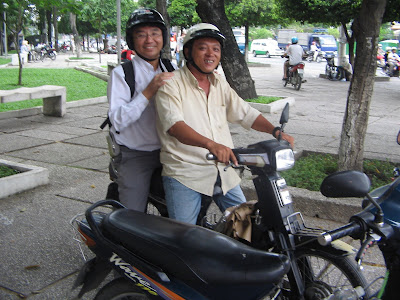
I went for a round-the-city trip on a motorcycle. The driver-on-hire has a management degree and used to work with a Japanese company.

There are more funs on the motorbike than on the tour bus, you can bet!